
Why autistic communication is more than verbal vs nonverbal
In autistic communication or not, speech is not communication. Speech is just one tool for expressing language, not the same thing as communication itself. You can have words without meaning, and meaning without words, and for many autistic people, the challenge isn’t having something to say, but reliably getting it out through speech.
Sometimes, talking feels like trying to pull words through thick water. I know exactly what I want to say. The idea is clear, even detailed; fully formed somewhere inside me. But when it’s time to speak, something between thought and mouth doesn’t quite connect. Words scatter. Sentences start and stop. The structure doesn’t come out right.
And sometimes, I go quiet, not because I have nothing to say, but because I can’t always get what’s inside me to come out the way I need it to.
There’s something else I’ve noticed over the years that I don’t hear many people talk about. I’ve lost parts of my language.
I grew up in a Yoruba-speaking environment in Nigeria. There was a time I could speak it with some ease. But like other things I once held without thinking, it started slipping. Even English — the language I use most, the one I love, the one I used to study almost obsessively, collecting new words the way some people collect other things — sometimes feels unstable in my mouth now. Words I once knew confidently don’t always come to mind when I need them. I reach for them and find a strange blankness where they should be.
And when I’m overwhelmed, particularly by sensory input, speech doesn’t just slow. It can almost shut off entirely. Not because I’ve stopped thinking. But because my brain is too crowded to translate what’s happening inside into spoken language.
I share this not because it’s unique to me. I share it because it’s one of the realities of autistic communication that most people never hear described from the inside and because understanding it changes how you see many of the situations we’ve been discussing throughout this series.
Autistic communication spectrum within the spectrum
In the previous pieces, we looked at how autistic communication differs in style, including the role of directness, literal language, masking, and the Double Empathy Problem. But there’s a dimension of communication in autism that goes beyond style, and it’s this: not all autistic people communicate through speech at all, or not consistently, or not in the same way across situations.
Approximately 30% of individuals with autism are nonverbal or minimally verbal, with little to no spoken language. That is roughly one in three. And yet the dominant conversation about autism and communication still tends to centre almost exclusively on the verbal majority.
This matters because the assumptions we make about speech — what it means when it’s present, what it means when it’s absent — affect everything from how children are educated to how adults are treated in healthcare, employment, and everyday life.
The first assumption worth dismantling is this one: that not speaking means not understanding. It doesn’t.
Receptive language — the ability to understand — and expressive language — the ability to produce speech — are different processes in the brain. Some autistic people understand far more than they can express verbally, for reasons that have nothing to do with intelligence or comprehension and everything to do with the physical and neurological mechanics of producing spoken language. Equating the two does real harm to real people who get underestimated every single day.
Why some autistic individuals don’t speak, and why it’s not what most people assume
When someone doesn’t speak or speaks inconsistently, the assumption is often that they don’t have language. But that’s frequently not what’s happening.
One of the most significant factors is apraxia of speech, a motor planning disorder that affects the brain’s ability to coordinate the precise movements needed to produce speech. One extensive study found that approximately 64% of children diagnosed with autism also had apraxia, supporting the hypothesis that speech motor planning issues are common in this population.
Think about what that actually means. The person knows what they want to say. The language is there, understood, and organised. But the pathway between intention and the physical act of speaking — the sequencing of jaw, tongue, lips, breath — isn’t working reliably.
Children with apraxia typically show inconsistent sound errors, difficulty sequencing sounds, and groping behaviours (a “searching” movement of the mouth or tongue) but often retain better social understanding and receptive language skills.
This disconnect between what someone understands and what they can produce is one of the most misunderstood aspects of autism. And it is why verbal ability is not, and never should be, used as a proxy for intelligence, awareness, or comprehension.
Beyond apraxia, sensory overload plays a major role. As we’ve explored in depth in earlier posts, when the nervous system is overwhelmed, the brain prioritises managing incoming sensory input. In those moments, speech can become temporarily inaccessible even for people who are usually verbal. It’s not a choice. It’s a physiological response to an overloaded system. The words are still there. The access to them isn’t.
Anxiety and environment are equally significant. Something called ‘selective mutism’, where a person can speak in certain contexts but not others, is distinct from consistent non-speaking, but it illustrates something important: the ability to use spoken language is not fixed. It fluctuates. It is sensitive to how safe, regulated, and supported a person feels in a given moment.
What non-speaking autistic people are doing when they’re “not communicating”
Imagine you have a rich inner world — thoughts, opinions, feelings, humour, frustration, curiosity — but the system that translates all of that into spoken language is unreliable. You’re not silent because you have nothing to say. You’re silent because the bridge between what’s inside and what comes out isn’t working the way other people’s does.
Now imagine that people around you routinely assume, because you’re not speaking, that you don’t understand. That they speak about you rather than to you. That your competence is estimated based entirely on your speech output. That nobody thought to hand you a device, or a keyboard, or any other way to get what’s inside out.
This is the reality for many non-speaking autistic people. And it is why the expansion of Augmentative and Alternative Communication (AAC) is one of the most important developments in autism support of the past few decades.
AAC encompasses a wide range of tools: speech-generating devices, communication apps, picture exchange systems, sign language, typing, and writing. These are not last resorts or substitutes for “real” communication. For many people, they are their primary language, reliable in ways that speech simply isn’t. A substantial proportion of adults with autism do not develop fluent language by adulthood.
Autistic adults frequently experience communication barriers impacting relationships, employment, and health. These are barriers that arise from multiple sources, including unaccommodating environments and communication partners, not only from language differences themselves.
The gap is not just about access to AAC devices. Research reveals that many families are not even aware that AAC devices exist and that they could ask for one. This is a systems failure with real consequences for real people. And it means that many non-speaking autistic individuals are spending years without the tools they need to communicate, not because the tools don’t exist, but because nobody told them they could have one.
Thinking about autistic communication differently
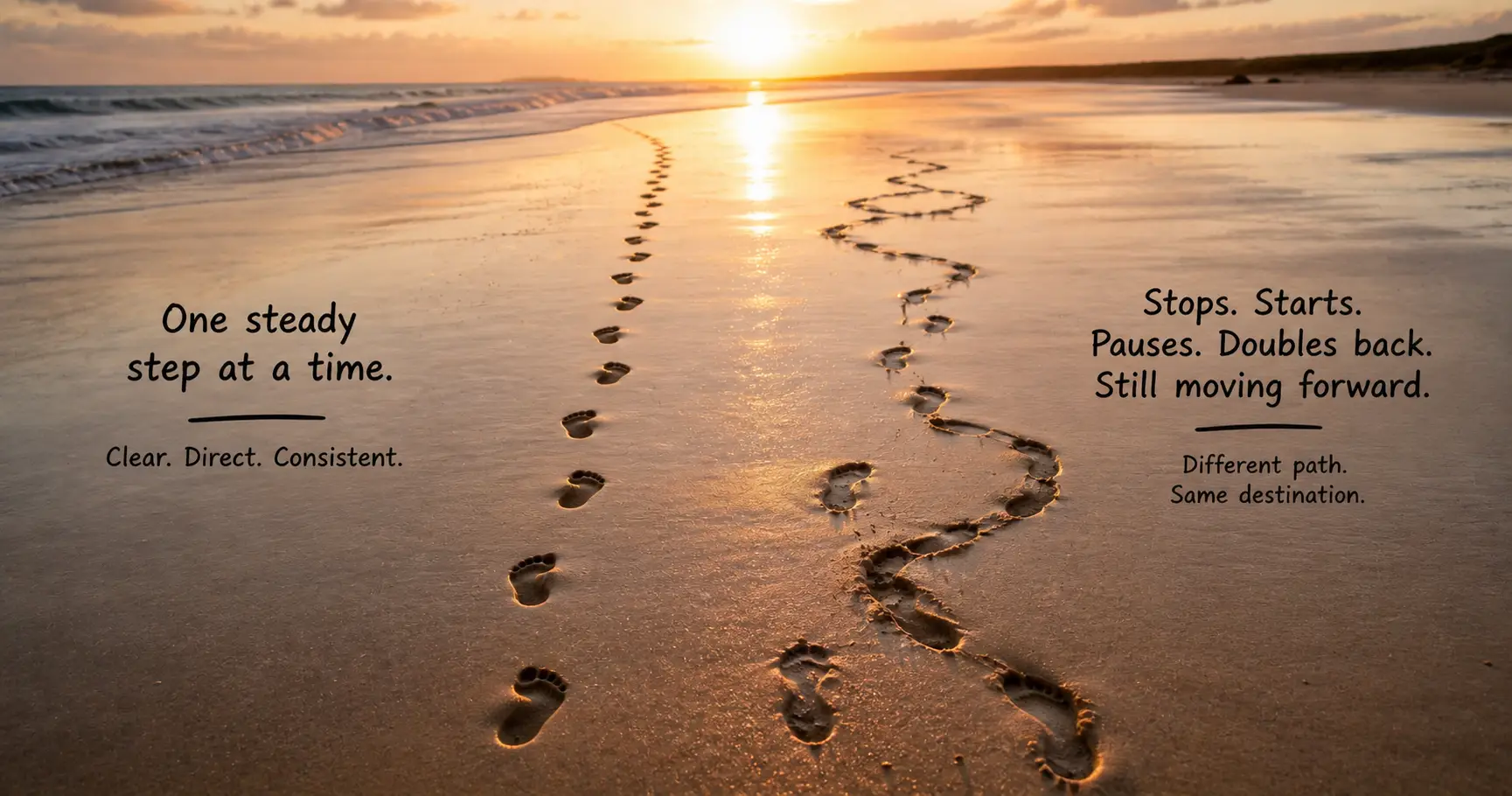
The “verbal or non-verbal” binary is one of the least useful ways to think about autistic communication. It implies a fixed, permanent state, when the reality for many autistic people is far more dynamic than that.
Consider the range that actually exists: some autistic people have fluent, consistent speech and communicate easily across most situations. Some have speech that’s reliable in low-stress environments but becomes inaccessible during overload, illness, or anxiety.
Some use speech in some contexts and AAC in others, depending on what’s most effective in the moment. Some are non-speaking consistently and use alternative methods as their primary and most reliable language. And some are somewhere in between all of these, varying across days, years, and life circumstances.
Rather than asking, “Is this person verbal or non-verbal?” — a question that’s actually about a single snapshot — the more useful question is, “How does this person communicate most effectively, and what supports allow that communication to happen?”
That shift in framing changes everything. It moves from categorisation to access.
What environment actually does to communication
One thing that often gets missed in conversations about autistic communication is how much the environment shapes what’s possible.
Pressure to speak when speech isn’t accessible doesn’t unlock it. It tends to increase anxiety, reduce regulation, and make communication harder, not easier. This is particularly important to understand in classrooms and workplaces, where the expectation of verbal response is baked into almost every interaction.
Giving processing time, such as pausing after asking a question or resisting the urge to repeat or rephrase immediately, is one of the simplest and most effective adjustments available. It costs nothing and changes a great deal.
Offering multiple ways to respond, including verbally, in writing, through a device, or through gesture, removes the pressure of a single accepted route and increases the likelihood that communication actually happens. Research recommends that services move away from reliance on phone calls and instead ensure that access to support is not dependent on any single communication mode, offering written options such as email and live messaging, which are more accessible. This applies as much to schools, workplaces, and healthcare settings as it does to any other service.
And assuming competence — speaking directly to the person, not about them; acknowledging all forms of communication as valid; not treating speech as the only reliable indicator of understanding — is not just courtesy but accuracy. Because the person who is not speaking may be the most attentive in the room.
Going back to the beginning
I mentioned at the start that I’ve experienced a fading of language, such as words slipping, a reduction in bilingual ability, and linguistic access becoming less reliable over time. I don’t say this to be dramatic, and I’m not describing something catastrophic. But it’s real, and I think it reflects something that matters.
Communication isn’t static, even within a single person. It changes with exhaustion, with sensory load, with burnout, with age, with circumstance. The person who communicated fluently last year may be struggling this year. The person who couldn’t access speech last month may find it more available this month. None of that reflects a fundamental shift in who they are, their intelligence, or their capacity for connection.
It just reflects the truth of how complex and variable communication actually is, particularly for those of us whose nervous systems are working harder than most just to get the words out.
Understanding that variability is not a sign of inconsistency to be corrected or explained away. It’s information. And responding to it with flexibility rather than judgement is one of the clearest ways to show that you actually understand what communication in autism is about.
Not a single mode. Not a fixed state. Not a deficit to overcome. A different way of getting there.